
Koyomi (暦, "calendar") is dates for Phoenix. It gives your app:
- pickers for LiveView forms: a day, a range of days, several days, a month, an ISO week, a year, a time, a day and a time (in a time zone, or from the time slots your LiveView offers), and a repeat rule;
- fields of segments in the order of the locale (
15/03/2027,03/15/2027,2027/03/15), typed or changed with the arrow keys, and dates typed in words, with a preview: "next friday", "in 3 weeks", "15–20 mar", "amanhã às 9h"; - calendars in any locale and in the calendar systems of the browser: Japanese, Buddhist, Persian, Islamic, Hebrew, Chinese and more, with the locale's digits, first day of the week and direction;
Koyomi.Rules, the same rules in the browser and in your changeset, so that what the calendar disables is what the server refuses;- Ecto types for what the pickers post, PostgreSQL
daterangeandtstzrangeincluded, and the same ranges as text or JSON for SQLite and MySQL; - day content from your LiveView: prices, full days, marks and time slots, as for a booking;
Koyomi.Test, to pick values inPhoenix.LiveViewTestwith no browser.
The pickers are a prebuilt JavaScript bundle in the Hex package. Your app does not run Node.js for them: you add the hook and one style sheet.
Try it: Notebook
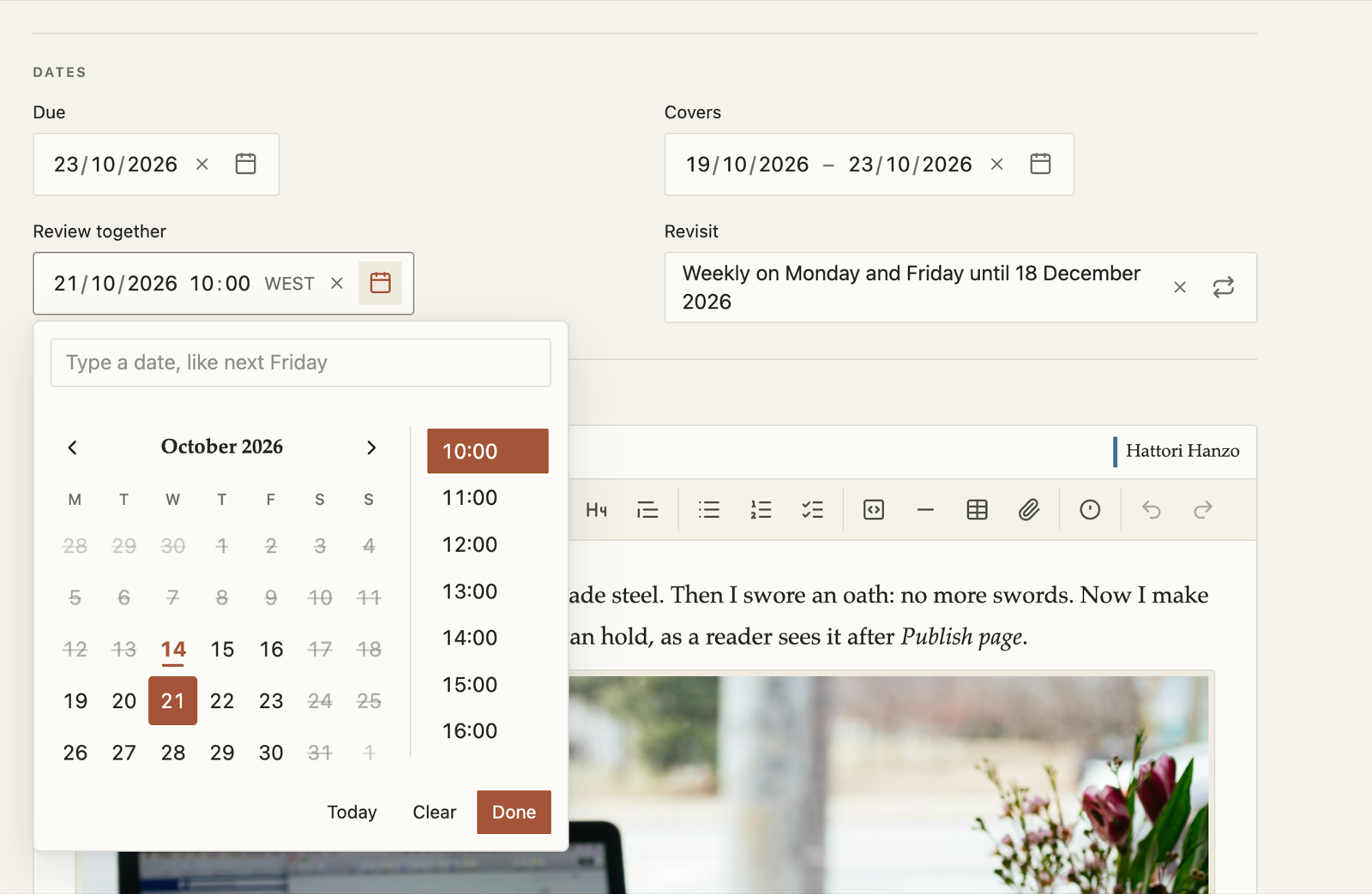
Notebook is a complete Phoenix
app made with Koyomi and Kotoba. Each page has a due date, the days it
covers, a review on a day and a time from the free slots, and a repeat
rule; the changeset checks the same rules as the calendar, and the
notebook's own calendar shows the days of every page. Clone it, run
mix setup and mix phx.server, and sign in as Hattori Hanzo (its
README has the details) to try every picker in your browser.
What the pickers do
| Pickers | date_picker, date_range_picker, dates_picker, month_picker, week_picker, year_picker, time_picker, datetime_picker, recurrence_picker, and calendar for a calendar on the page |
| Fields | segments in the locale's order and digits, typed or changed with the arrow keys, the number keyboard on a phone, two-digit years, paste |
| Words | dates, ranges and times typed in words, in English, Portuguese, Spanish, French, German, Italian, Dutch and Japanese, and month and weekday names in every locale, with a preview |
| Calendar | one or more months side by side, a list of months that scrolls on a phone, months and years to jump to, week numbers, holidays of 26 countries, presets |
| Ranges | drawn as the pointer moves, the length in days or nights, days out of reach disabled while the end is chosen |
| Rules | bounds relative to today, disabled days, ranges and weekdays, the shortest and longest range, counts, times and steps; the same in Koyomi.Changeset |
| Locales | names, digits, first day of the week and weekend from the browser's CLDR data, right-to-left languages, the 12 or 24-hour clock |
| Calendars | Gregorian, ISO, Japanese, Buddhist, ROC, Persian, Islamic (four kinds), Hebrew, Chinese, Dangi, Indian, Ethiopic, Coptic |
| Time zones | today in a zone, wall clock times posted with the zone's offset, the hour the clocks skip or repeat shown and resolved |
| Day content | labels, tones, marks, descriptions, disabled days and time slots from the LiveView, in sync or async, refreshed on demand |
| Forms | the forms of the browser's own inputs (2027-03-15, 2027-W11), the browser's own input before the hook mounts, phx-change and used_input?, pages without LiveView |
| Filters | plain params and URLs as well as Ecto forms: a range's keys of your own (start and end), and relative values, where a chosen preset posts its key (last_7_days) and stays relative in a shared link |
| Types | Koyomi.DateRange, Koyomi.DateTimeRange, Koyomi.Dates, Koyomi.Month, Koyomi.Week, Koyomi.Recurrence |
| Repeat | daily, weekly, monthly and yearly rules (RFC 5545), said in words in eight languages, with the next dates |
| Theming | CSS custom properties, the Sumi theme, dark mode, forced colours, reduced motion |
| Accessibility | a labelled group of spinbuttons, a dialog, the WAI-ARIA grid with one tab stop, announcements, 44px targets on touch screens |
Install
Koyomi needs Elixir 1.18 or later (it uses the built-in JSON module),
Phoenix 1.7.14 or 1.8, and Phoenix LiveView 1.1 or later.
Add koyomi to the deps in mix.exs:
def deps do
  [
    {:koyomi, "~> 0.2"}
  ]
end
Then run:
mix deps.get
mix koyomi.install
The installer adds the hook to assets/js/app.js and the style sheet to
assets/css/app.css, and prints what it changed. Give --dry-run to see
the changes first. It does not add what a file already has, so you can
run it again.
The manual steps
To make the same changes by hand, import the hook in assets/js/app.js
and add it to the hooks of the LiveSocket:
import { Koyomi } from "koyomi"

const liveSocket = new LiveSocket("/live", Socket, {
  params: {_csrf_token: csrfToken},
  hooks: {...colocatedHooks, Koyomi},
})
Import the style sheet in assets/css/app.css (and the Sumi theme, if you
want it: Sumi is the design system of Hattori AI, the makers of Koyomi
and Kotoba). Put these lines below the other @import lines of
app.css:
@import "../../deps/koyomi/priv/static/koyomi.css";
/* @import "../../deps/koyomi/priv/static/koyomi-sumi.css"; */
A date and time picker with a time_zone other than UTC, and rules with a
:time_zone, need a time zone database on the server, such as
tz or
tzdata:
config :elixir, :time_zone_database, Tz.TimeZoneDatabaseNODE_PATH=deps
import { Koyomi } from "koyomi" resolves through the NODE_PATH of your
esbuild profile, which must have deps/. The Phoenix generators already
set it. If your profile has no NODE_PATH, add it in config/config.exs:
env: %{"NODE_PATH" => [Path.expand("../deps", __DIR__), Mix.Project.build_path()]}Use
schema "bookings" do
  field :check_in, :date
  field :stay, Koyomi.DateRange
end

@stay_rules Koyomi.Rules.new(min: :today, max_days: 14)

def changeset(booking, attrs) do
  booking
  |> cast(attrs, [:check_in, :stay])
  |> Koyomi.Changeset.validate_range(:stay, @stay_rules)
end
<.form for={@form} phx-change="validate" phx-submit="save">
<label id="stay-label">Stay</label>
<.date_range_picker field={@form[:stay]} label_id="stay-label" rules={@stay_rules} months={2} nights />
</.form>Import the components in the html_helpers of your web module:
import Koyomi.ComponentsEach picker posts its value with the form, in the form of the browser's
own inputs (2027-03-15, or stay[from] and stay[to] for a range), so
the form's own phx-change and phx-submit events have it, and the Ecto
type of the field casts it.
Guides
- Quickstart: install, the schema, the form and the changeset.
- Pickers: every picker, what it posts and its attributes.
- Forms: what the pickers post, errors, pages without LiveView, values set by the server.
- Filters and URLs: plain params, a range's own keys, and relative values that stay relative in a URL.
- Rules:
Koyomi.RulesandKoyomi.Changeset. - Typing: the segments, and dates typed in words.
- Calendars and locales: locales, calendar systems, week numbers and holidays.
- Time zones: today in a zone, offsets, the hours the clocks skip or repeat.
- Day content: labels, marks, disabled days and time slots from the LiveView.
- Recurrence: the repeat picker and
Koyomi.Recurrence. - Testing:
Koyomi.TestwithPhoenix.LiveViewTest. - Theming: the
--koyomi-*properties and the Sumi theme. - Accessibility: the roles and the keyboard.
- Known limits.
Development
The picker source is TypeScript in assets/. The built files in
priv/static are not in the repository; the Hex package has them.
mix deps.get
mix koyomi.build    # npm ci in assets/ when necessary, then esbuild
mix dev             # the development server on http://localhost:4099
mix koyomi.build runs in the :dev environment and needs npm. It
empties priv/static and writes the four files of the package:
koyomi.esm.js, koyomi.cjs.js, koyomi.css and koyomi-sumi.css.
mix dev runs dev.exs: a Phoenix endpoint with every picker in a form
(/), day content from a fake availability service, slow and async
(/days), the calendar systems of the world (/calendars), a page
without LiveView (/plain), and the Sumi theme at /?theme=sumi (and
&dark=1), or on one of Sumi's seven themes at ?sumi=smoke. Every
page takes locale, calendar and zone query params. Set PORT for
another port. An esbuild watcher rebuilds the bundle, and the page
reloads.
Tests
mix test                   # the ExUnit suite
mix test --include build   # also mix koyomi.build and mix hex.build
mix test.js                # the unit tests of the TypeScript modules
mix test.e2e               # the Playwright browser tests
mix precommit              # compile, format, credo --strict and test
mix dialyzer
mix test.js runs the tests of the pure modules in assets/test/ (the
date arithmetic, the locales and calendars, the words parser and the
recurrence rules) with Node's test runner. test/fixtures/recurrence.json
holds the recurrence rules to the same results in Elixir and in
TypeScript.
The browser tests in e2e/ use Playwright, in Chromium, Firefox and
WebKit (the engine of Safari). Install the browsers once:
cd e2e && npm ci && npx playwright install chromium firefox webkit
mix test.e2e runs every spec in the three browsers, and E2E_BROWSERS
picks some of them. It runs npm ci in e2e/ when e2e/node_modules
is missing, builds the bundle, and starts its own development server,
without watchers, on port 4098 (set E2E_PORT for another port). A
mix dev on port 4099 can keep running.
Release
mix release (in this repository, an alias that replaces Mix's release
task) builds the bundle, checks that priv/static holds only the four
bundle files (mix koyomi.release_check), publishes to Hex, and tags
and pushes v<version>.
Contributing
See CONTRIBUTING.md: when a change needs an issue first, and what a pull request needs. Report a security problem privately, as SECURITY.md says.
License
Koyomi is released under the MIT License. See LICENSE.
The icons are from Lucide (ISC License; some from Feather, MIT License),
and the table of week data by region follows the Unicode CLDR (Unicode
License v3). See NOTICE.